
Description
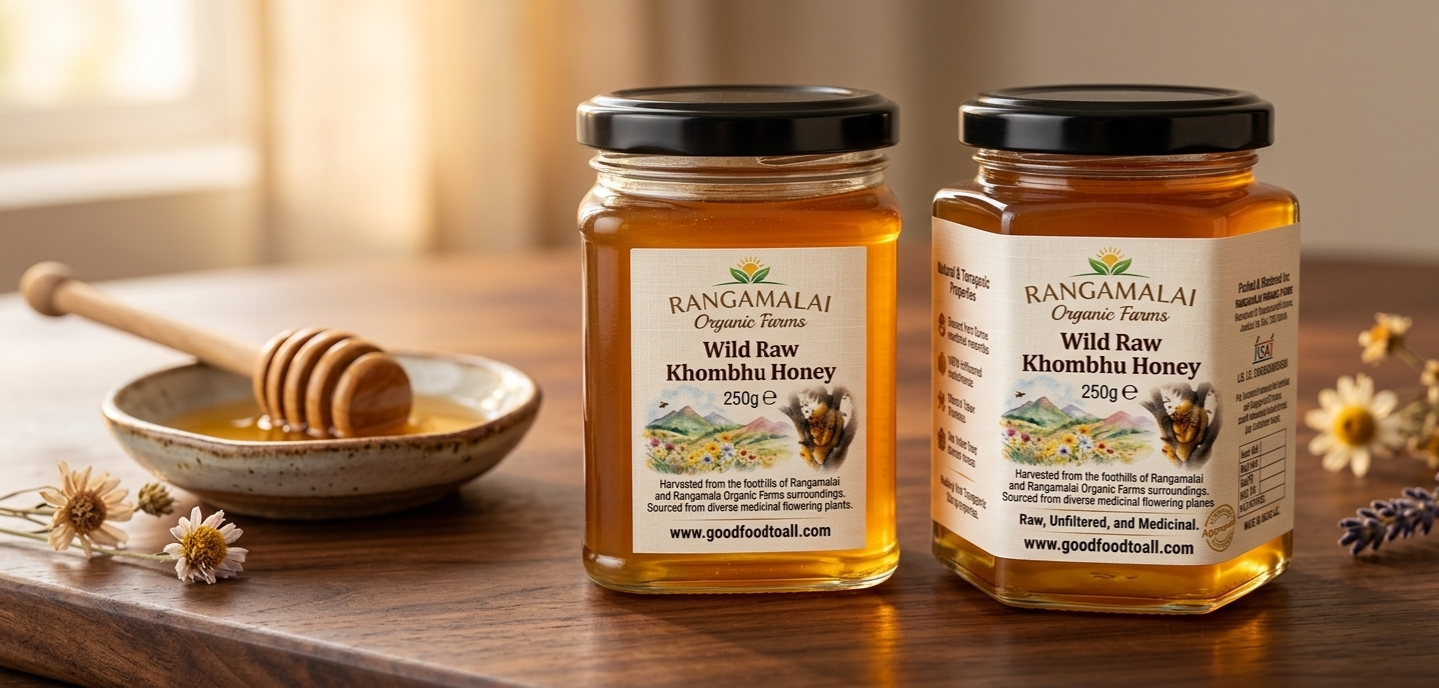
Khombu Honey
Wild-harvested from the world’s smallest honeybee, Apis florea, in the forest foothills of Karur, Tamil Nadu.
The smallest bee,
the rarest honey.
Kombu Then is the colloquial Tamil name for honey produced by Apis florea — the dwarf honeybee, the smallest honey-producing bee species in the world.
Unlike the Apis mellifera used in commercial beekeeping, Apis florea cannot be domesticated in hive boxes. It lives entirely in the wild, building single open combs on low forest bushes. Each colony is small — 500 to 2,000 bees — and each comb yields less than a kilogram of honey per season.
Because the bees are so small, they reach the nectaries of tiny medicinal flowers that larger bees cannot enter. The result: a honey exceptionally dense with pollen, phytochemicals, and the healing character of the Rangamalai forest itself.
The Rangamalai hills rise to 945 metres in the extreme south of Karur district — a biodiversity hotspot where 69 bird species and 35 butterfly varieties have been documented.
Our bees forage freely on hundreds of wild forest species. What blooms that season, they gather. What they gather becomes your honey. Each harvest is a record of a particular forest in a particular season — impossible to replicate, impossible to standardise.
A forest that remembers itself.
This is not another jar of honey.
Rarest Wild Honey in South India
Each Apis florea comb yields less than a kilogram per season. Our Khombu Honey is not manufactured — it is patiently gathered from the Rangamalai hills, one small wild nest at a time.
Raw — 120+ Bioactives Intact
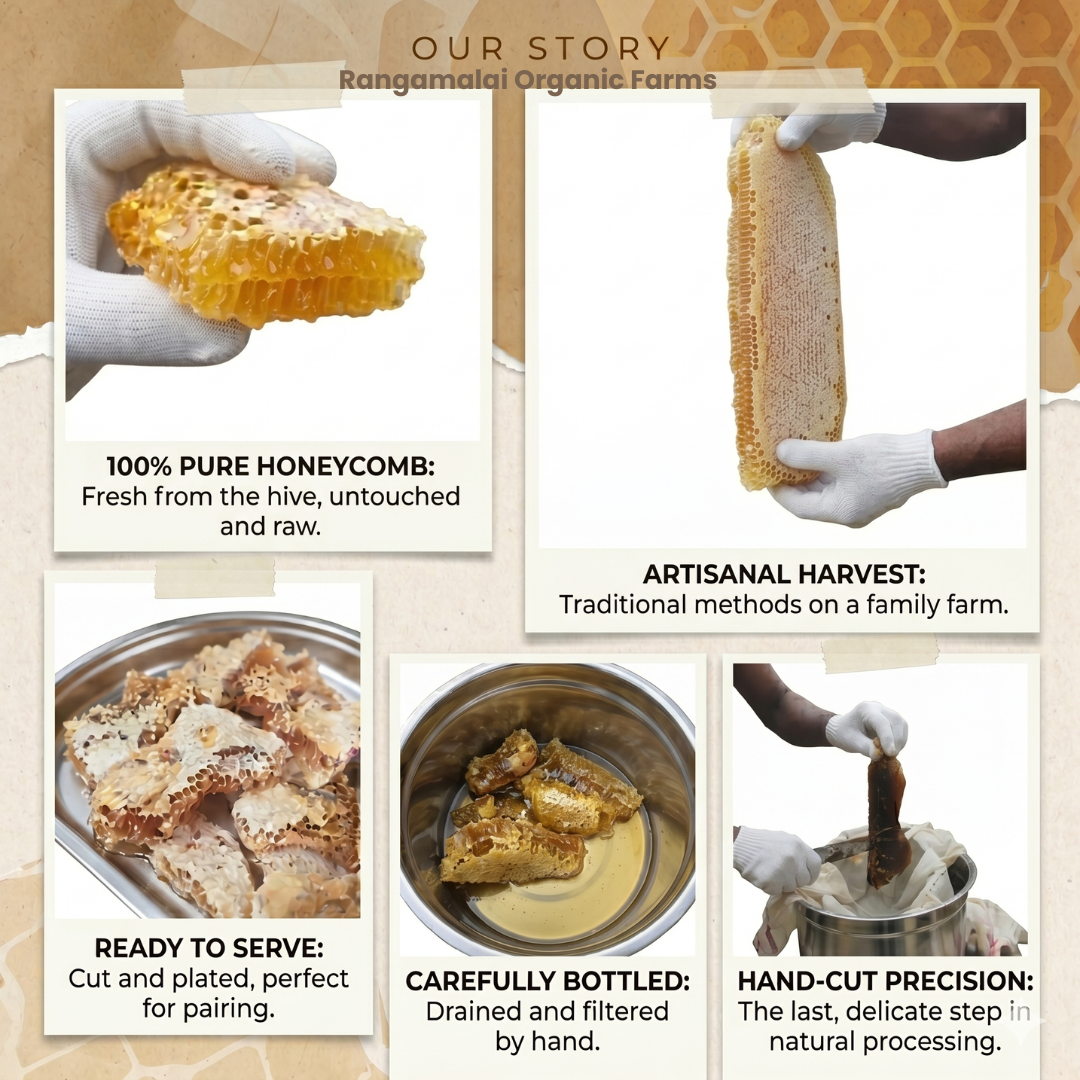
Never heated, never filtered. Commercial honey is pasteurised above 70°C, destroying up to 90% of digestive enzymes. Ours moves from forest comb to jar through a single cloth strain — nothing more.
Rooted in Tamil Siddha Tradition
Kombu Then has been used in Siddha medicine for millennia — for wound care, digestive health, respiratory support, and children’s immunity. We carry this forward, harvest by harvest.
Medicinal Flora in Every Drop
Our bees forage on Neem, Kadukkai, wild Tulsi and seasonal Rangamalai hill blooms. These plants transfer their phenols, flavonoids and terpenes directly into every spoonful.
Pollen-Rich Living Food
Because Apis florea is tiny, it reaches small medicinal flowers bigger bees cannot. Our honey is densely packed with bee pollen — amino acids, B-vitamins, zinc, iron. Ultra-filtered honey removes it all. Ours keeps it.
Single Origin, Fully Traceable
From the Rangamalai hills of Karur, Tamil Nadu — a UN One Planet Network–recognised biodiversity site. You know the bee, the forest, and the harvest season. Not a blend from unknown origins.
Ethical Wild-Harvesting
We take only honey-bearing combs, leaving the brood intact so each colony survives, rebuilds, and continues to pollinate the forest. This isn’t extraction — it’s coexistence.
Seasonally Honest
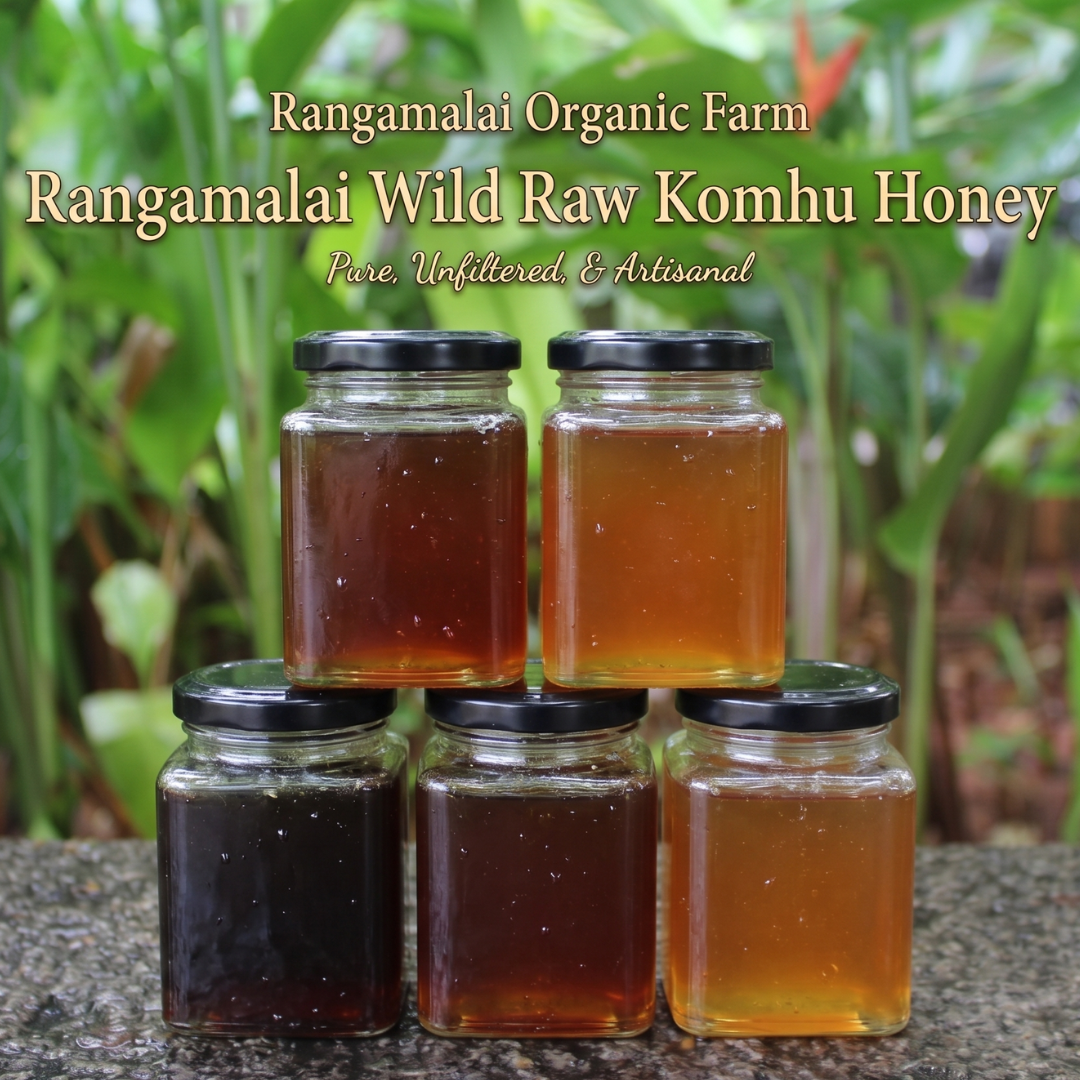
Each batch reflects the season’s blooms. Lighter and floral in wildflower season, deeper amber after a Neem flow. Variation is proof that your honey was never processed to look like every other jar on the shelf.
“Bees forgot it’s a bottle — not their home. That’s how pure our honey is.” Rangamalai Organic Farms
Khombu, Forest Honey, and the supermarket bottle.
Not all honeys are created equal. The bee species, hive type, harvesting method and processing each change the product fundamentally.
| Feature | Khombu (Apis florea) | Wild Forest (Apis dorsata) | Commercial (Apis mellifera) |
|---|---|---|---|
| Bee size | Smallest bee species | Large rock bee | Large farmed bee |
| Hive type | Small wild comb on bush | Giant cliff or tree comb | Man-made box hive |
| Yield | < 1 kg / comb / season | 5–10 kg / comb | 15–25 kg / hive / year |
| Floral source | Small medicinal herbs & shrubs | Forest canopy trees | Farm crops, often monofloral |
| Pollen content | Very high | Moderate | Filtered out |
| Processing | Raw, cloth-strained only | Usually raw | Pasteurised & ultra-filtered |
| Enzyme activity | Fully preserved | Moderate to high | Heat-destroyed |
| Flavour | Thin, aromatic, complex | Robust, smoky, intense | Uniform, mild sweet |
| Price (per kg) | ₹1,500 – ₹2,600 | ₹600 – ₹1,200 | ₹150 – ₹400 |
Six properties, recognised in tradition and in peer-reviewed research.
In Tamil Siddha and Ayurvedic medicine, honey (madhu) is not a sweetener — it is medicine. Modern phytochemistry is only now catching up to what Siddha healers have known for three thousand years.
Antimicrobial
Hydrogen peroxide from glucose oxidase, high osmolarity, low pH, and plant-derived phenolics combine to inhibit a broad spectrum of bacteria — including pathogens like S. aureus and E. coli.
Antioxidant
Peer-reviewed studies on Indian Apis florea honey show superior CUPRAC and superoxide-scavenging activity — neutralising the free radicals linked to ageing and inflammation.
Anti-inflammatory
Flavonoids like quercetin, kaempferol, and luteolin — present in dark, pollen-rich honeys — inhibit inflammatory signalling pathways including NF-κB.
Wound Healing
Used topically for 4,000 years — from ancient Egypt to modern clinical wound dressings. Honey promotes debridement, anti-inflammatory action, and new tissue formation.
Digestive Health
Raw honey’s amylase, invertase, and glucose oxidase aid digestion — enzymes which commercial heat processing destroys by up to 90%. Also acts as a natural prebiotic.
Immunity Support
Retained bee pollen delivers all essential amino acids, B-vitamins, zinc, and iron. A traditional Siddha daily tonic to strengthen vitality and resistance to seasonal illness.
Traditional medicinal uses reflect centuries of observed practice and are consistent with modern phytochemistry. This honey is a nutritional food — not a pharmaceutical substitute for medical treatment.
₹650 isn’t a price — it’s a story.
Authentic single-origin Indian wild honey sells for ₹300–₹900 per 500 g. Commercial supermarket honey sells for ₹150–₹250. They are not competing products. Here’s what your choice actually buys.
- Produced in managed box hives by farmed Apis mellifera
- Pasteurised at 70–80°C — enzymes & antioxidants destroyed
- Ultra-filtered — all pollen and traceability removed
- Often blended from multiple countries
- Permanently liquid & uniformly golden (processed)
- Wild-harvested from Apis florea in a named forest
- Never heated — 120+ bioactive compounds preserved
- Only cloth-strained — pollen, propolis & enzymes intact
- Single origin: Rangamalai hills, Karur, Tamil Nadu
- Seasonal colour & taste variation — the mark of living honey
- Rooted in 3,000 years of Siddha medicinal tradition
A single Apis florea comb yields less than a kilogram per season. Every gram in your jar is the result of a bee, a flower, a forest, and a patient human harvester. The Real Cost of Wild Honey
Four everyday rituals.
Morning Tonic
1 tsp in warm water or milk on an empty stomach — the traditional Siddha daily ritual for immunity & energy.
Nourishing Sweetener
Drizzle over curd, millet porridge, or fresh fruit. Stir into herbal teas (once cooled below 40°C).
Throat & Cough
Mix with crushed ginger or black pepper for sore throats, coughs and seasonal congestion.
Topical Care
Apply a thin layer to minor cuts, burns, or dry skin — used in Siddha practice for millennia.
Never give honey — any honey — to infants under 12 months due to risk of infant botulism. Those with diabetes should consume in moderation under medical guidance. Persons with pollen allergies should exercise caution. Store in a cool, dry place away from sunlight — do not refrigerate. Crystallisation is natural and a sign of purity; warm gently in a water bath (below 40°C) to reliquify. Never microwave.
Questions, honestly answered.
₹650 for 250 g seems expensive. Why?
You’re comparing two completely different products. Commercial honey is produced by tens of thousands of farmed bees, pasteurised, ultra-filtered, and blended from multiple regions or countries. A single Apis florea comb in the Rangamalai forest yields less than 1 kg per season. Finding, ethically harvesting, and preserving that honey raw requires skilled human labour, local knowledge, and patient care.
At ₹2,600/kg, Khombu Honey is still priced below many premium international honeys like Manuka or Sidr. You’re paying for rarity, purity, and medicinal value — not just sweetness.
Why does my honey look different from last time?
Because it came from living bees in a real forest. Every harvest reflects the season’s blooms. When Neem flowers in the Rangamalai hills, the honey carries its slightly bitter, medicinal undertone. When wildflowers bloom post-monsoon, it’s lighter and more floral.
Uniform appearance across every bottle = industrial processing. Variation = authenticity. Our honey’s personality changes with the seasons — just like nature intended.
My honey has crystallised. Has it gone bad?
Absolutely not — it’s the gold standard of purity for raw honey. High-glucose honeys crystallise faster; high-fructose ones more slowly. To reliquify, stand the jar in warm water (below 40°C) and stir gently. Never microwave raw honey — it destroys the enzymes and antioxidants you paid for.
Commercial honey stays permanently liquid because it’s been heated until the crystal-forming enzymes are destroyed.
How is this different from supermarket honey?
The difference is fundamental. Supermarket honey is typically: farmed (managed Apis mellifera); pasteurised at 70–80°C (destroying enzymes, antioxidants, pollen); ultra-filtered; and blended from multiple sources.
Rangamalai Khombu Honey is wild-harvested from a specific, named location; raw and unheated; pollen-rich; produced by a smaller, wild bee species foraging on medicinal plants; and genuinely scarce. It’s comparable to wild-caught fish versus farmed fish — same category, entirely different product.
Is raw honey safe? I heard it can have bacteria.
Raw honey is one of the most naturally antimicrobial foods known to science. Its combination of low pH, high osmolarity, hydrogen peroxide production, and phenolic compounds creates a hostile environment for nearly all pathogens. It has been used safely by billions of people for thousands of years.
The one exception: honey of any kind should never be given to infants under 12 months due to the rare risk of infant botulism. For everyone else, raw honey is safe and vastly more beneficial than processed honey.
How do I know this honey is genuine?
Rangamalai Organic Farms is a documented natural farm in Karur, Tamil Nadu, operating since 2015. The farm and its surroundings are recognised on eBird.org as a biodiversity hotspot and by the UN One Planet Network for our Community Seed Bank.
Simple home purity test: drop a small amount in a glass of water — genuine raw honey sinks and stays cohesive rather than dissolving quickly.
“Nature-approved. Bees certified. This isn’t just a bottle — it’s a promise.”


Reviews
There are no reviews yet.