
Description
Kothamalli Samba
🌾 A Grain Named After Coriander
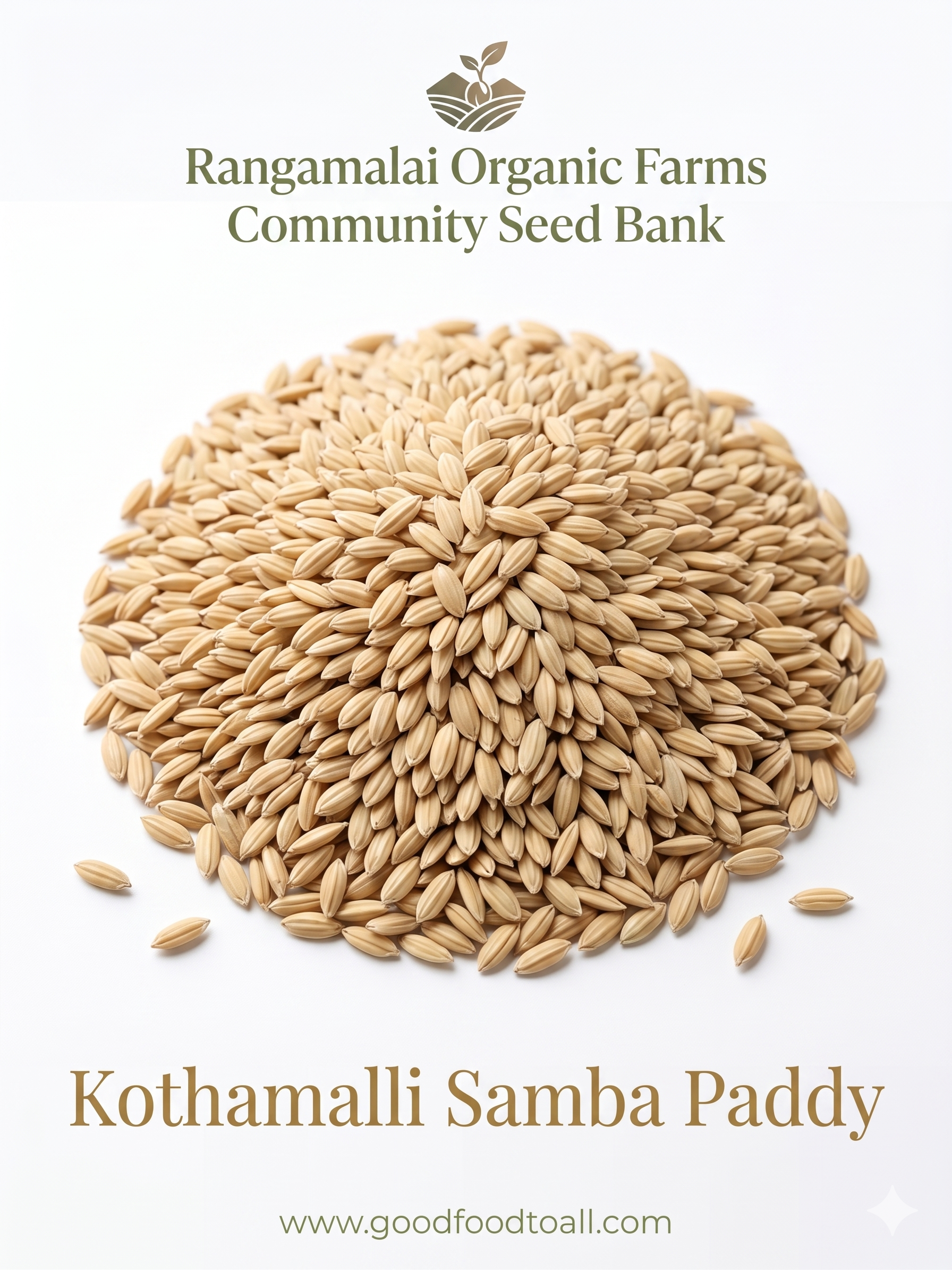
The name says it all. Kothamalli (கொத்தமல்லி) is the Tamil word for coriander, and this medium-grain samba paddy gets its name from the way its tightly clustered, oval grains resemble freshly harvested coriander seeds drying on a winnow. Samba denotes the principal Tamil Nadu cultivation season — the long, water-loving paddy season that runs from mid-July to mid-January.
Kothamalli Samba is predominantly cultivated in the Nagapattinam and Kanyakumari districts, where farming families have maintained the seed line through generations. Documented in the Traditional Rice Varieties of Tamil Nadu sourcebook by the Centre for Indian Knowledge Systems (CIKS, 2019), it stands out among traditional varieties for an unusually high protein content and a kitchen-friendly grain that cooks soft, digests easy and carries the gentle aroma characteristic of unpolished samba rices.
At Rangamalai Organic Farms, we conserve Kothamalli Samba as part of our community seed bank effort — not as a commodity, but as living heritage you can plant, eat and pass forward.
📋 Agronomic Properties
| Seed Type | Paddy (Oryza sativa) |
| Name of the Variety | Kothamalli Samba (கொத்தமல்லி சம்பா) |
| Native Region | Nagapattinam & Kanyakumari districts, Tamil Nadu |
| Cultivation Season | Samba — July 15 to January 14 (sowing: Aug–Sep; harvest: Jan–Feb) |
| Crop Duration | ~135 days (medium-duration) |
| Crop Habit | Tall traditional samba type, moderately tillering |
| Paddy (Husk) Colour | Straw-gold, medium-slender husk |
| Rice Colour & Grain | Dull white, medium grain (~6.5 mm); resembles coriander seed |
| Quality | Medium rice quality; soft cooking, easy digesting |
| Water Requirement | Standard wetland paddy; tolerates Cauvery delta conditions |
| Seed Class | Open-pollinated, true-to-type; suitable for seed saving |
Source references: CIKS Traditional Rice Varieties of Tamil Nadu Sourcebook (2019); Namma Nellu variety register; ICMR-NIN Indian Food Composition Tables.
💚 Key Properties & Health Benefits
Tested at ~9.03 g protein per 100 g of rice — notably higher than common polished white rice (typically 6–7 g), making it a more satisfying staple for growing children, expectant mothers and active adults.
Documented as high in iron and calcium — supportive for haemoglobin levels and bone strength, particularly valuable in vegetarian Tamil households where rice is the carrier of daily mineral intake.
The medium grain cooks soft and is traditionally recommended as a gentle, easy-to-digest rice for small children, elders and convalescents. Works beautifully for kanji (porridge) and weaning meals.
Performs well as table rice, idli/dosa batter, puttu, kanji and traditional snacks like vadagam and murukku. Holds shape when cooked yet remains soft on the palate.
As a traditional non-hybrid variety preserved by farming communities for generations, it has natural adaptation to Tamil Nadu’s monsoon rhythm and lower dependency on external chemical inputs.
Open-pollinated and true-to-type — you can save your harvest’s best panicles as next season’s seed. Every plot of Kothamalli Samba you grow is one more living gene bank.
Nutritional values from the CIKS sourcebook on Traditional Rice Varieties of Tamil Nadu and ICMR-NIN Indian Food Composition Tables. Health-related properties are based on traditional and documented uses; this product is not intended to diagnose, treat or cure any disease.
🧪 Seed Treatment & Sowing Method
Follow the time-tested Tamil paddy seed treatment sequence used at Rangamalai Organic Farms. This sequence selects only viable seeds, primes them for fast germination and protects the young seedling from soil-borne disease — all using natural inputs.
Step 1 · உப்பு கரைசல் (Uppu Karaisal) — Salt-Water Selection
Dissolve common salt in water until a fresh hen’s egg just floats with a one-rupee-coin-sized portion above the surface (~20 % salinity). Pour the paddy seeds in and stir. Discard the seeds that float — these are immature or hollow. Collect the heavy, viable seeds that settle at the bottom and rinse them thoroughly in clean water 2–3 times to remove all the salt.
Step 2 · பஞ்சகவ்யா / பீஜாம்ருத் Soak — Bio Priming
Soak the cleaned seeds for 12–24 hours in any one of the following organic preparations:
- Panchakavya 3 % — 30 ml panchakavya per 1 L water
- Beejamrutha — fermented mix of cow dung, urine, lime, forest soil, water
- Plain water + jaggery — 1 tsp jaggery per litre as an energy primer (simplest option)
Step 3 · Sprout Incubation (முளைப்பாகுதல்)
Drain the seeds completely. Wrap loosely in a damp, clean cotton cloth or jute sack and keep in a warm, shaded place for 24–36 hours. Sprinkle a little water if the cloth dries out. Tiny white root tips (1–2 mm) will emerge — the seeds are now ready for sowing.
Step 4 · Bio-Coating for Disease Protection
Just before sowing, dust the sprouted seeds with Trichoderma viride (4–10 g/kg) + Pseudomonas fluorescens (10 g/kg). This bio-shield prevents damping-off, blast and other fungal/bacterial issues during the seedling stage.
Step 5 · Sowing — Nursery or Direct
- Nursery Method (preferred): Broadcast sprouted seeds on a well-prepared raised nursery bed (நாற்றங்கால்). Transplant 21–25-day-old seedlings into puddled main field with 20 × 15 cm spacing.
- Direct Sowing (broadcast): Suitable for small organic plots — sow sprouted seeds evenly into puddled, well-drained soil.
- Nutrient sprays during growth: Fish amino acid at day 20, Karpoora Karaisal at day 35, Panchakavya at day 50 (post-transplant timeline).
📘 For complete diagrams, sowing calendar and Tamil-language guidance, refer to the ROF Seed Treatment Guide and the ROF Seed Sowing Calendar linked in the gardening guides section.
Our ROF Community Seed Bank distributes traditional, open-pollinated seeds in small quantities with one clear request — grow them, save the seed, and become a custodian yourself. Every household that grows Kothamalli Samba helps keep this 100+ year-old line alive.
வித்தே வேளாண்மையின் ஆதாரம் · Seeds are the foundation of agriculture


Reviews
There are no reviews yet.